Techy stuff
Lifecycles hardware can be broken down into the following groups; Transport, Electronics and Power.
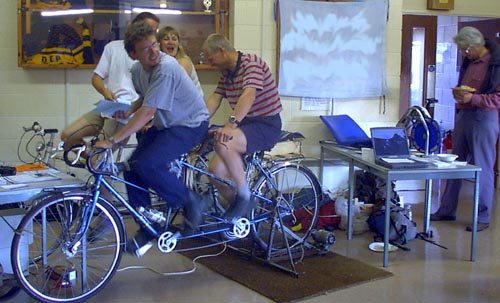
The transport consists mostly of peoples own personals bikes, as well as a tandem we bought and a tandem we borrowed. We also have the use of a home built quad and a trike that is amazingly difficult to steer - but these are really only useful for off road events such as festivals.
Personal
tat and all the electronics etc. are carried in bike trailers. We have
one small commercial two wheeled bike trailer and a home built trailer
that is in need of some work.
The electronic tat varies from event to event but generally consist of our LCD video projector, a video player, an audio amplifier and speakers.
The projector has a 120 watt bulb, consumes about 190 watts in total and requires 240 volts AC. The audio is usually provided by a portable stereo radio cassette which has an auxiliary input and has been converted to run on 12v.
Originally we used an old full size VHS camcorder as a 12v video player but we have now got a miniDV camera which is currently our main video source although we aim to get a cheap VCD/MP3 player to perform this task to save wear on the camera.
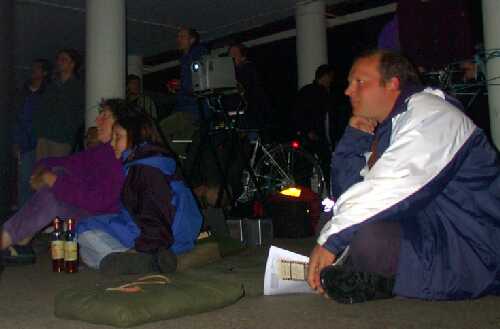
The power is provided mostly by pedal generators. Generally two tandems are placed side by side and lashed together to give them stability. The back wheels are lifted off the ground and placed into a stand that incorporates massive dynamos made from permanent magnet motors taken from whirlpool washing machines.
The rear wheels of the tandems are aligned so that they spin small (2inch) rubber coated wheels on the motors shafts. The vast difference in size between the 26inch bike wheels and the wheel on the motor provides a high gearing ratio and is more than adequate to get the motor spinning fast enough to generate a decent voltage.
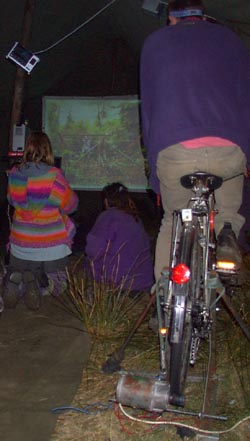 On
average, people on pedal generators seem to be able to maintain about
50 watts for long periods. For short bursts they can manage well over
100 watts. With four people pedalling, we can get the 200 or so watts
we estimate we need to run the equipment. However, people tend to slack
off during a film and there are change over periods when there may be
nobody pedalling for a short period. We have to use batteries able to
cope with these periods of full load.
On
average, people on pedal generators seem to be able to maintain about
50 watts for long periods. For short bursts they can manage well over
100 watts. With four people pedalling, we can get the 200 or so watts
we estimate we need to run the equipment. However, people tend to slack
off during a film and there are change over periods when there may be
nobody pedalling for a short period. We have to use batteries able to
cope with these periods of full load.
As long as the batteries and load are large enough, they will act to regulate the voltage from the generators (which are otherwise unregulated). Open circuit, the generates can kick out over 70 volts although adjusting the bikes gears can lower the voltage to better match requirements. We use 12 volt batteries, generally two 15Ah sealed lead acid gellies (commonly used for golf carts and invalid carriages - not ideal but fairly small, light and easy to obtain second hand ).
The 240volts required for the projector is provided by an inverter. We originally used a cheap modified sin wave unit but it seemed very inefficient and generated a nasty buzz via the audio. We had to run the audio equipment from a separate battery but have since purchased a nice expensive (and heavy) true sine wave inverter which solves the problem.
Photovoltaic solar panel supliment our power. During the day they top up any losses from the previous performance and provide power for music etc while on the road. We have 100 watts total capacity with two different types of PV panel. (We would be happy to share our experiences and thoughts regarding purchase of PV panels)
Problems with the original system
-
The rear tyres tend to wear quite badly using this system of drive. This could be solved if we could find more suitable rubber wheels. Ours were made out of wood turned on a pole lathe and covered with a bit of inner tube.
-
The whole thing is held together with lashings and every time you set it up, it is slightly different. It takes experience to set up and get working and the alignment between bike wheel and generator is hard to maintain with random members of the public jumping on and off.
-
The efficiency doesn't appear to be as good as it could be. It is also quite noisy.
Good points
-
We've proved it can be done! Many of the alternative energy people we talked to about the project said it was mad. Perhaps they were right, but we've done it anyway.
- It is inspiring. People are amazed by the fact we can do this with old washing machine parts and quite a few have gone on to build (or try to build) something similar themselves.
- We didn't need
to modify the tandems and the generator stands can be used with most
standard bikes. This means we can use bikes instead of tandems for demonstrations
of pedal power at green events, or use just one tandem if need be.
-
Only the solar panels, inverter and trailer were bought new. Everything else was bought second hand, borrowed or built from recycled bits. The generators were built for next to nothing which was handy because we had little money left after buying the video projector.
Next stage?
Regenerative braking would be nice. If the generators were fixed to the bikes when we were on the road, we could charge the batteries while when rolling down hills.
The system could be much easier to set up and require less technical know-how. There could be clamps instead of lashing and plugs and sockets instead of wires twisted together and covered in tape.
Over the winter we looked into using hub motors, like those found on many electric bikes, in order to solve some of the problems associated with our pedal power setup. We have now done some fund raising and so will soon be buying a couple (if we can solve the sourcing problems - advice welcome).
We generally avoid buying new tat so the grant to buy new stuff is a bit of a compromise. However, it is not uncommon for other people to ask us how to build similar systems and it sometimes seems a little elitist to say that you have to hang around recycling centres and be good at improvising in order to do it. It may be less elitist to give the information required for people to opt for buying off-the-shelf components while still providing DIY advice.
If you want to know more about what we have done and how we did it then please do get in touch.
See also: Our wish list; tat we need, tat we want.
